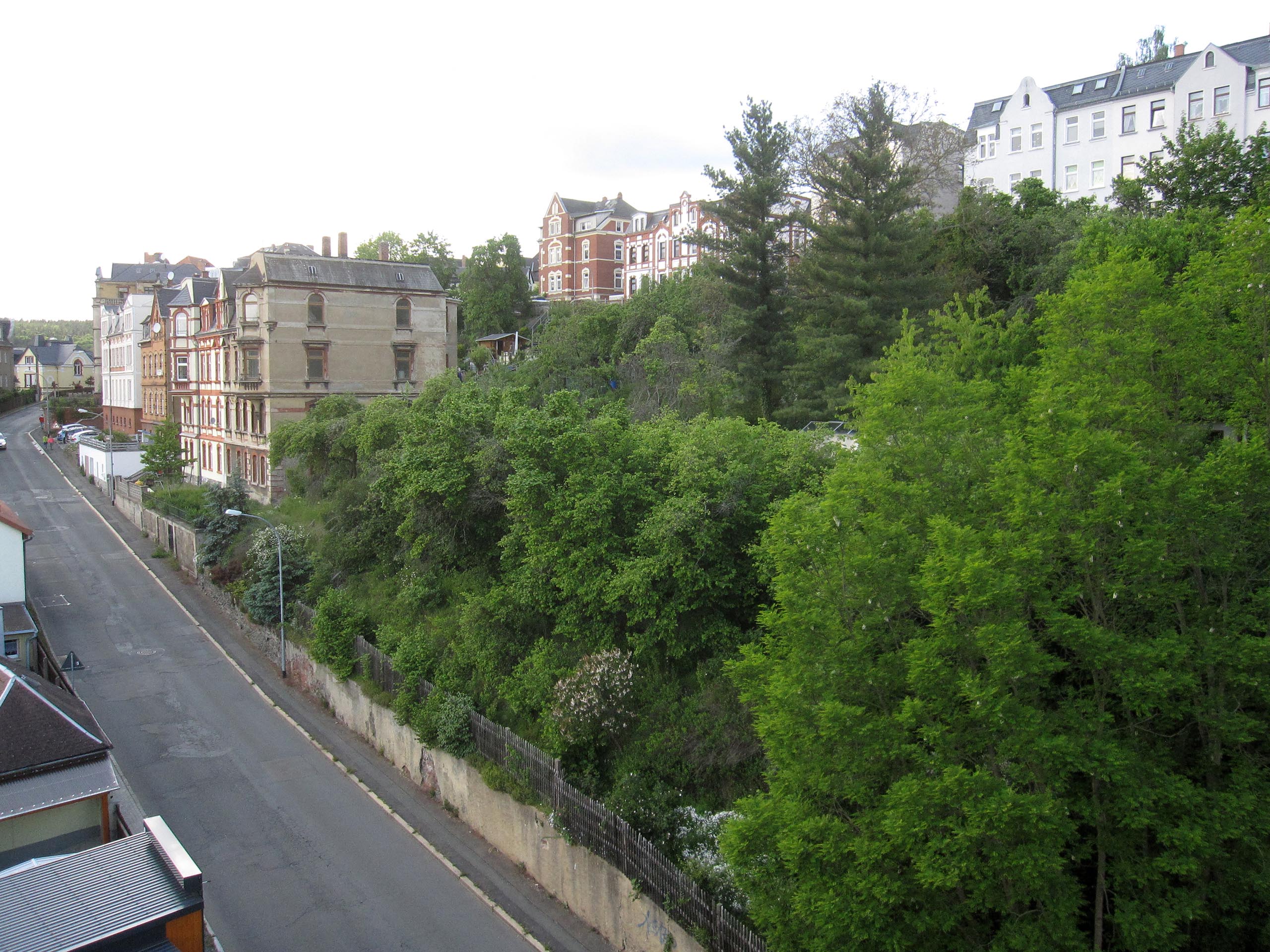
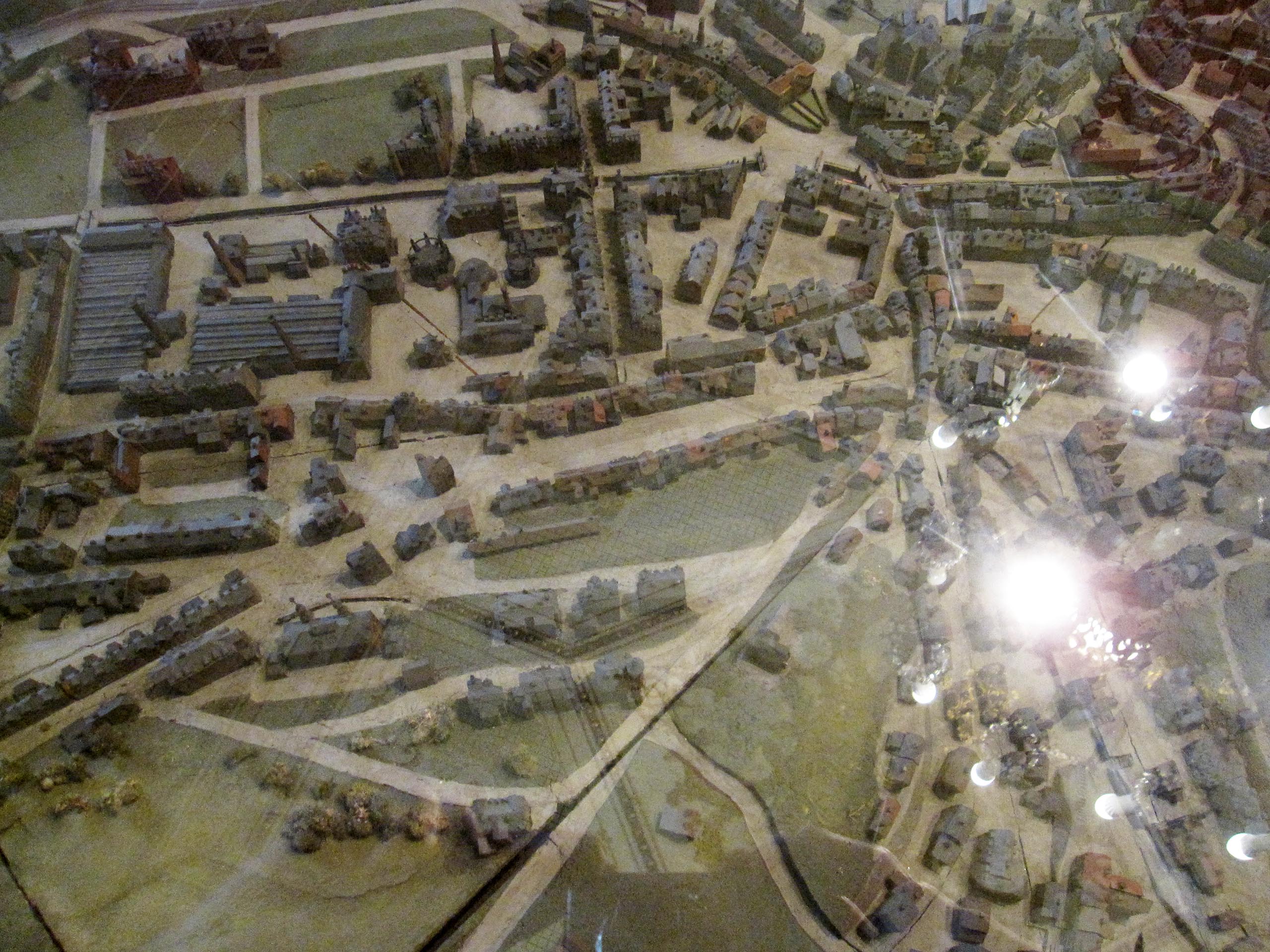
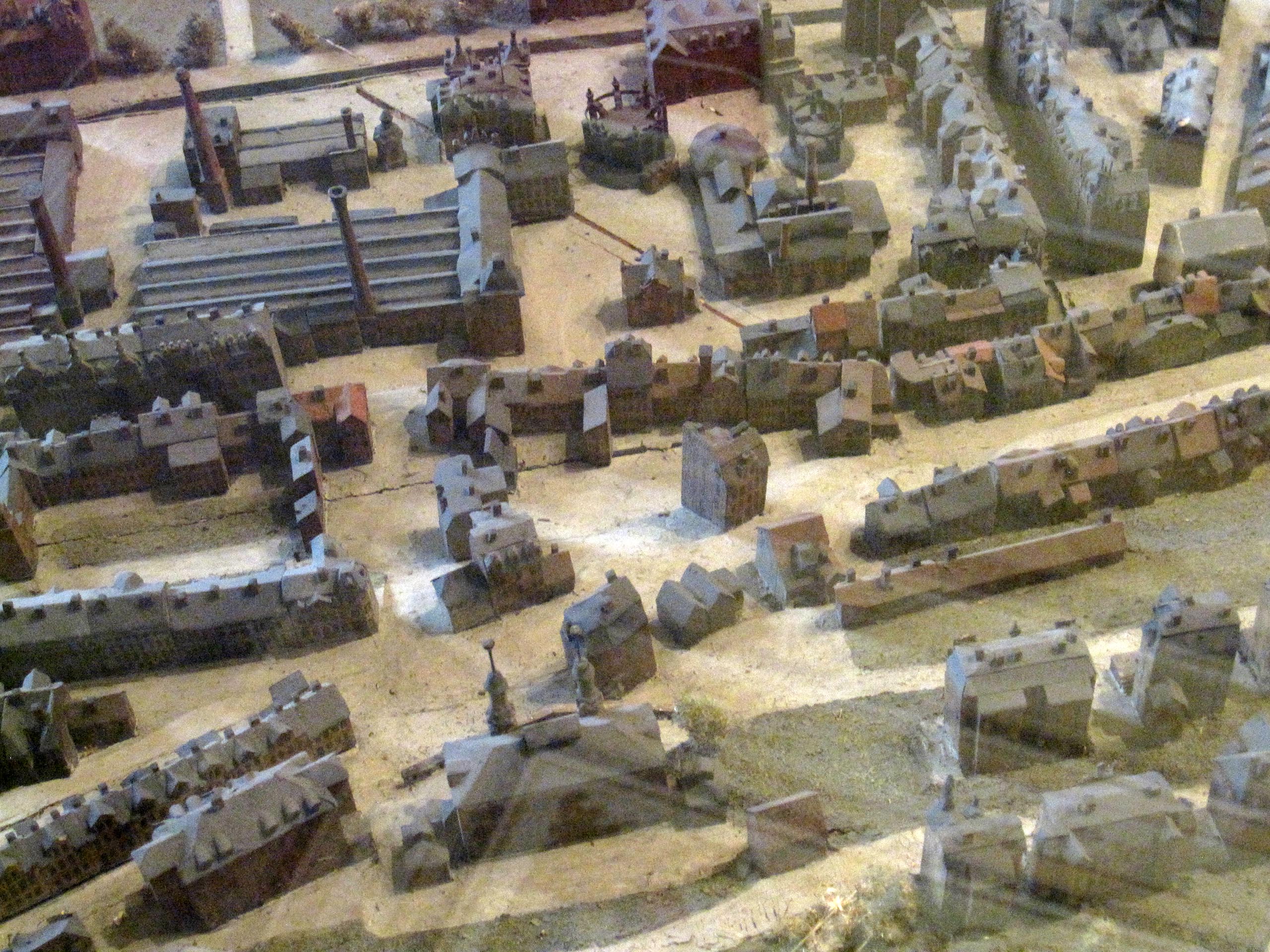
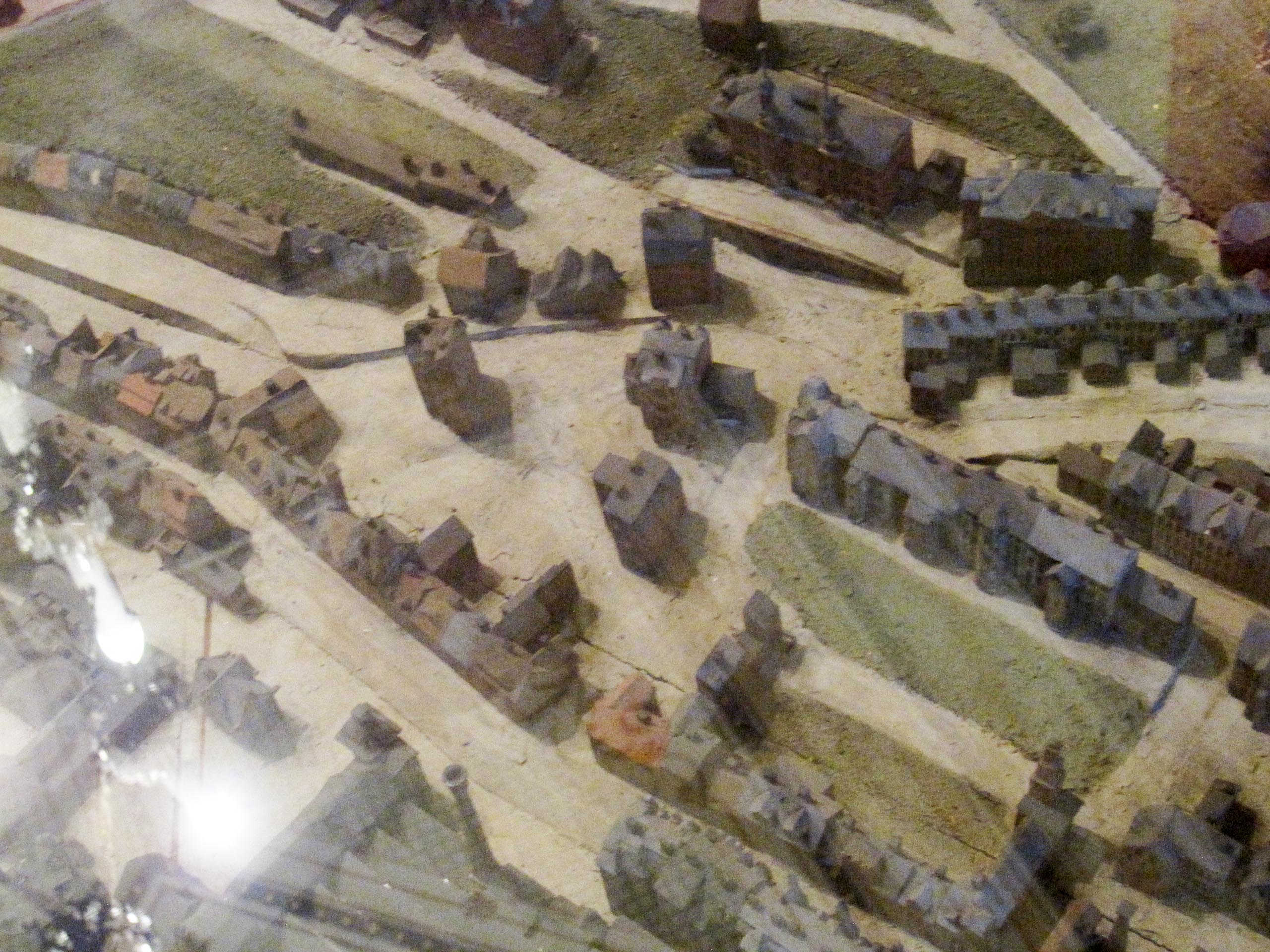
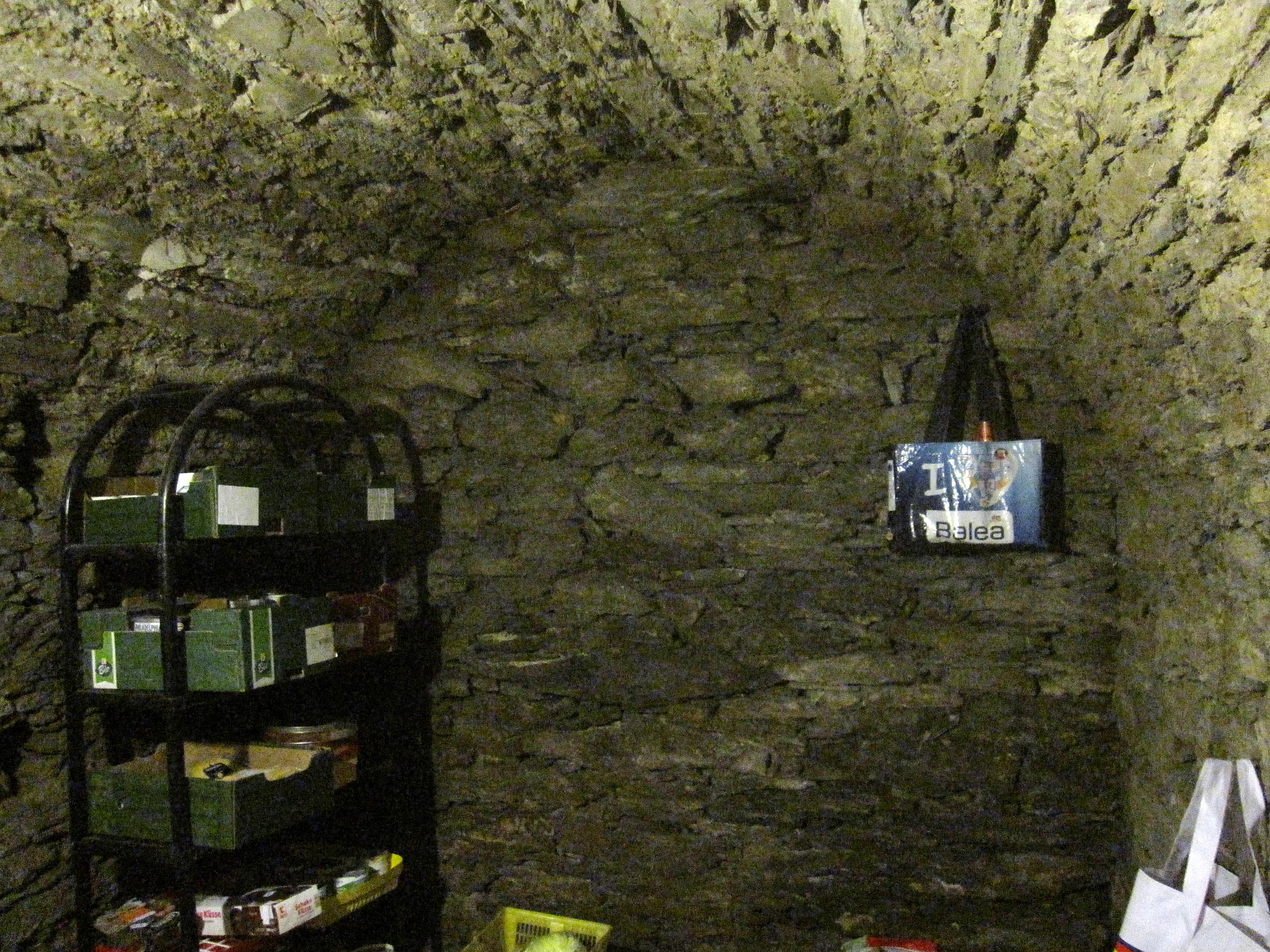
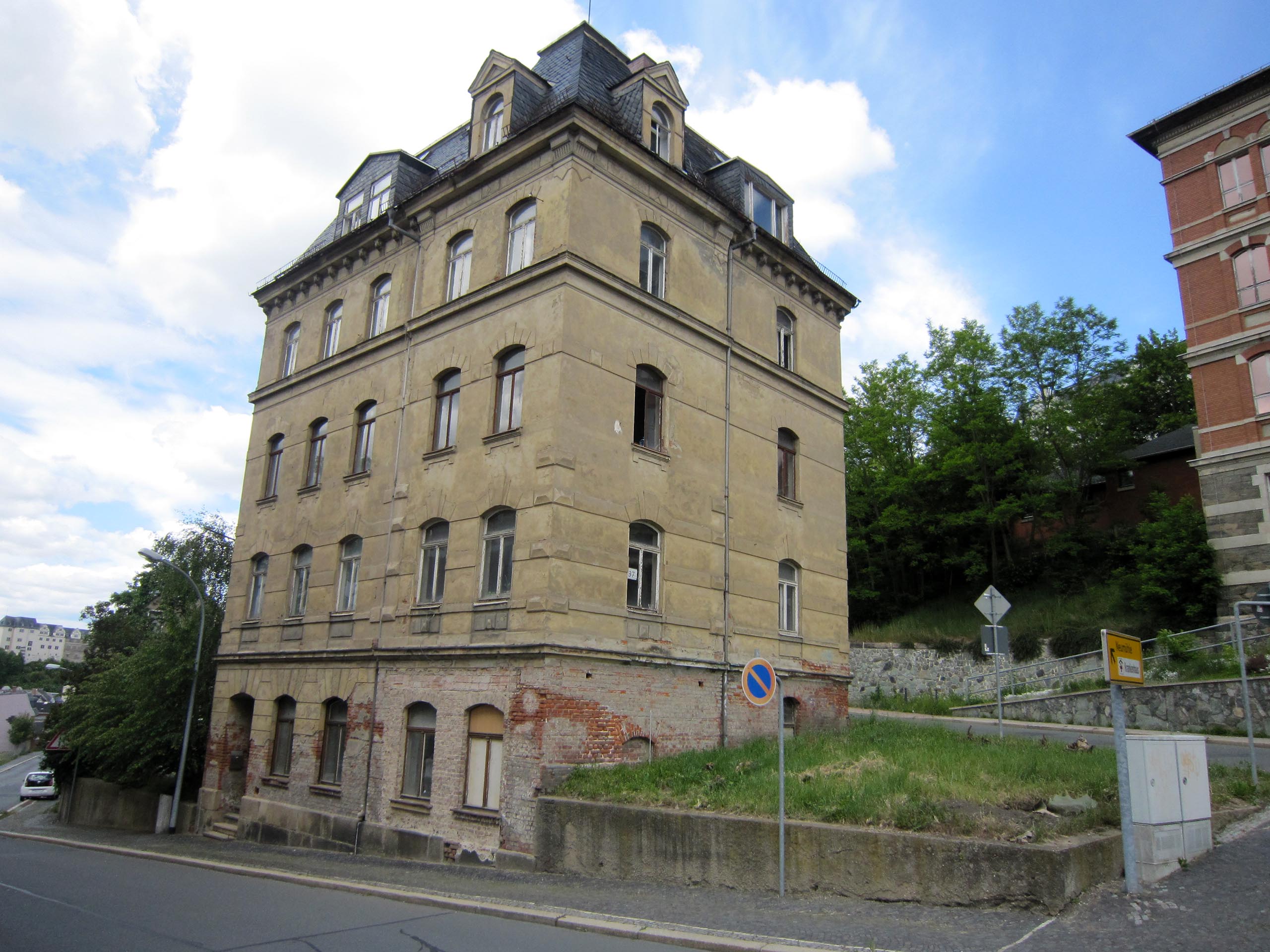
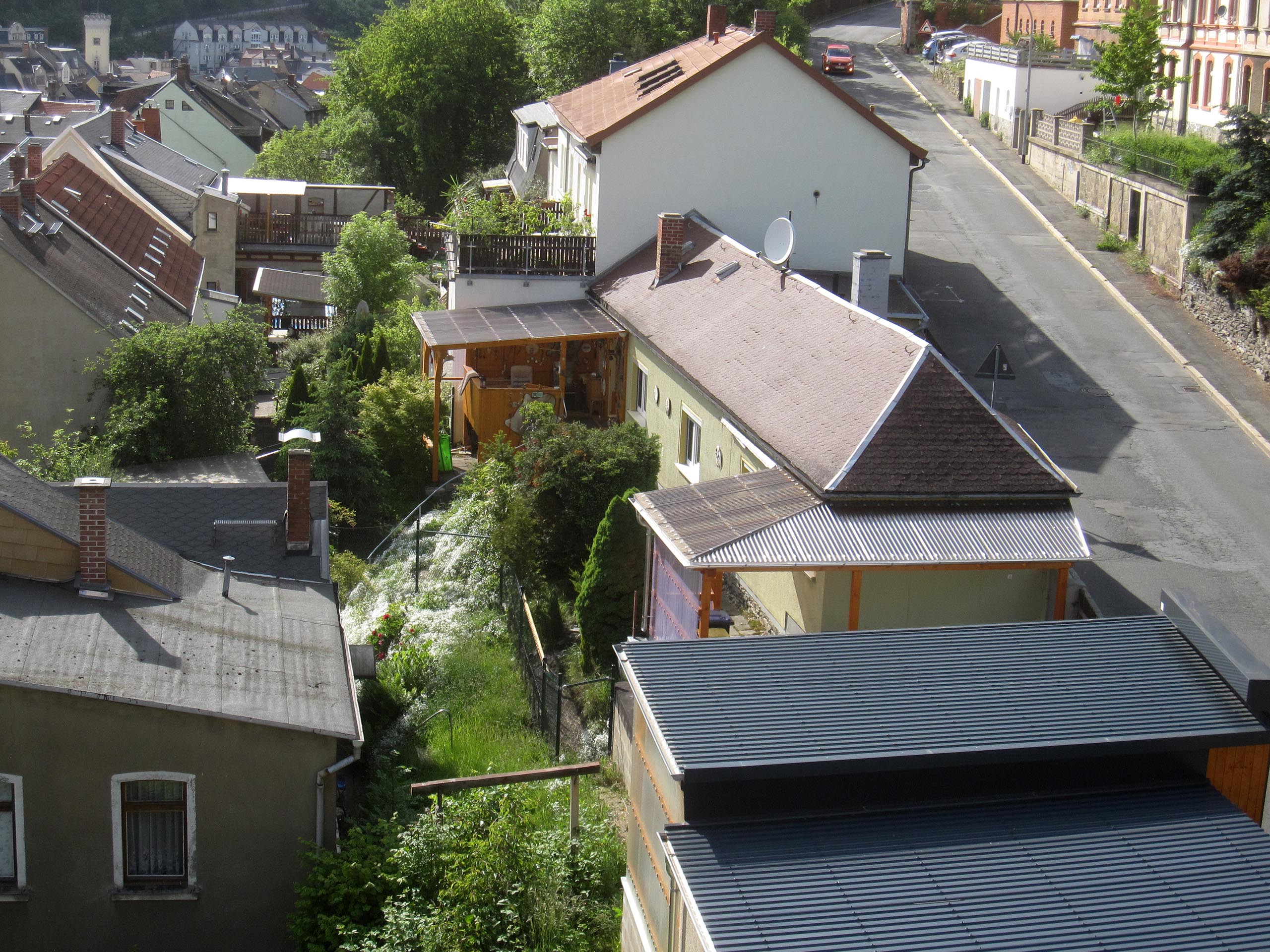
View from the upper floor of House No. 37. Panorama of the town of Greiz with the Upper Castle and the church.
Victor Dietel owned a plot of land in the town center as well as a large property not far from the center.
Pohlitzberg- Lehmgrube
According to the plan dated 24 May 1894 (n.Rep. A. Cap XIV Nr. 270 Bl. 40), Victor owned the adjacent hillside plot of about 12,000 m² next to his house. Possibly after an exchange of land with the town, the tenement house was built on the plot that had previously belonged to the district school. Today this area is known as the “Old Town” district. At the same time, opposite the site at the intersection of Obere Silberstraße, Lindenstraße, and Pohlitzerstraße, the girls’ school building was constructed and ceremonially opened on 28 March 1894. In the mid-1890s a new street (Cloßstraße) was planned across Dietel’s property.
Behind the Marstall Buildings
The “Urban Development Plan of Victor Dietel” from 1878 (signature I.2.b.-013, 3-95-1300 — cartographic collection of the State Archive in Greiz) shows a plot belonging to Victor in the town center of about 6,000 m², located between the present-day streets August-Bebel-Straße, Friedrich-Neumann-Straße, and Mollbergstraße.
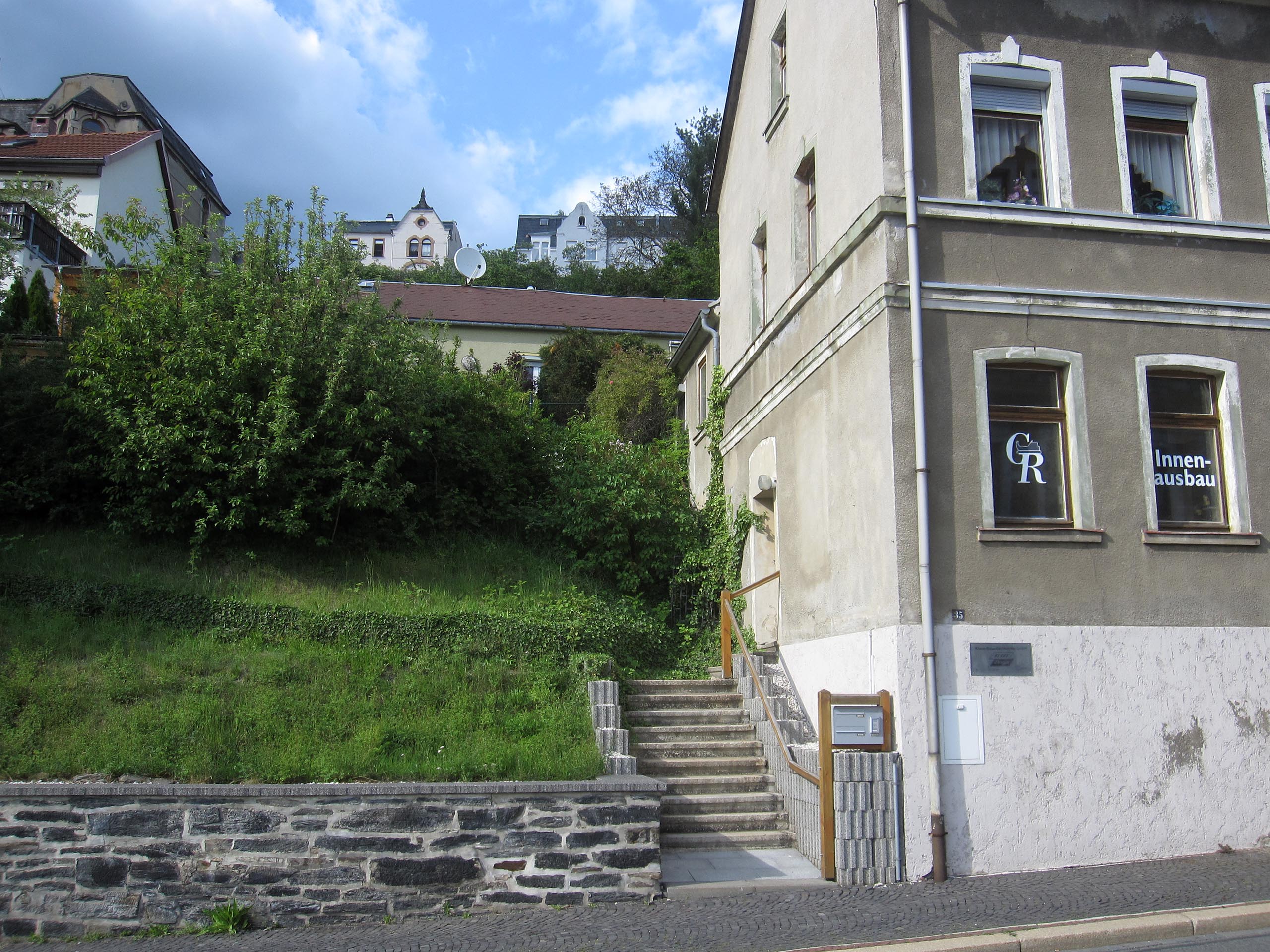
House No. 35 on Obere Silberstraße
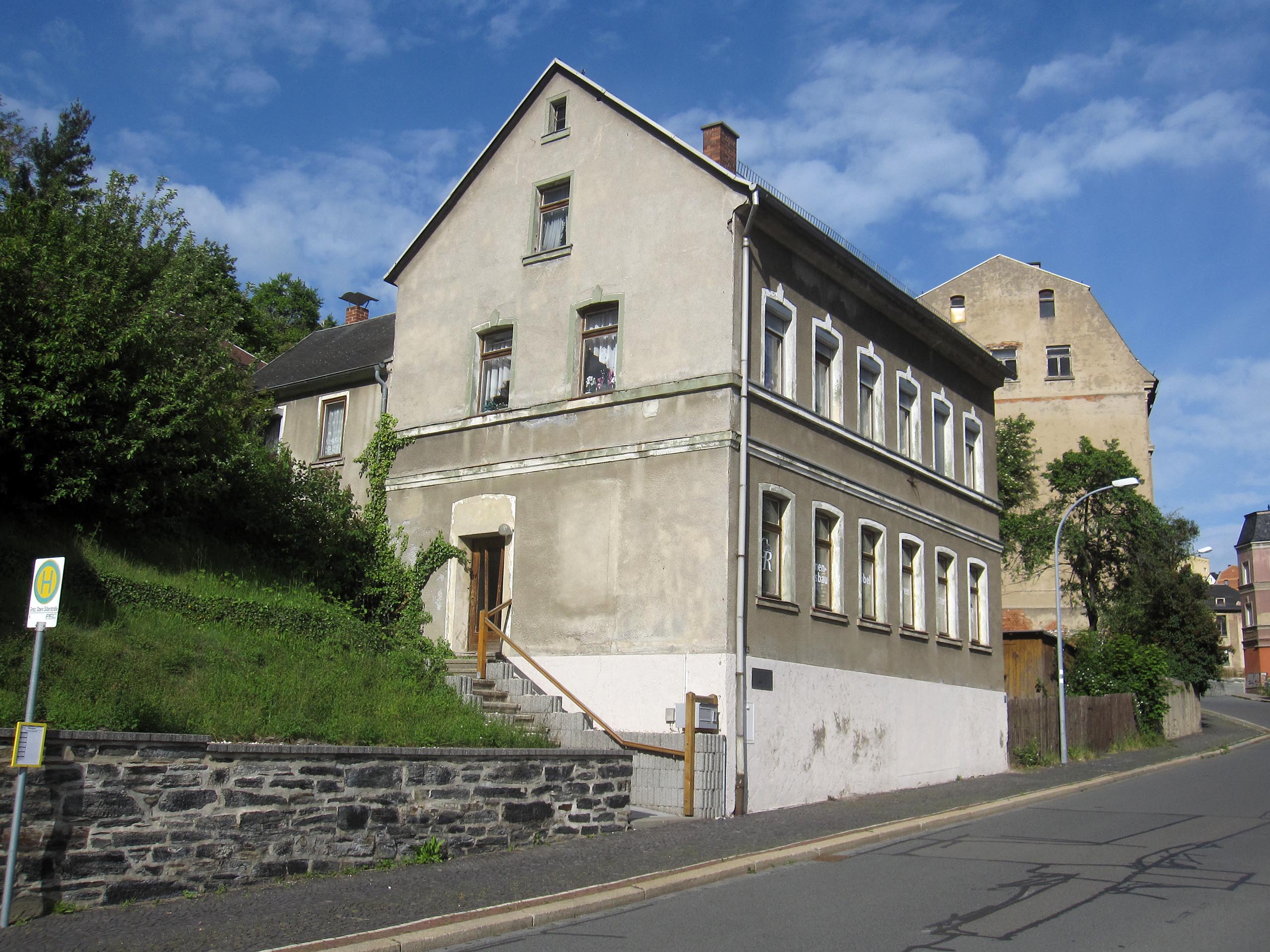
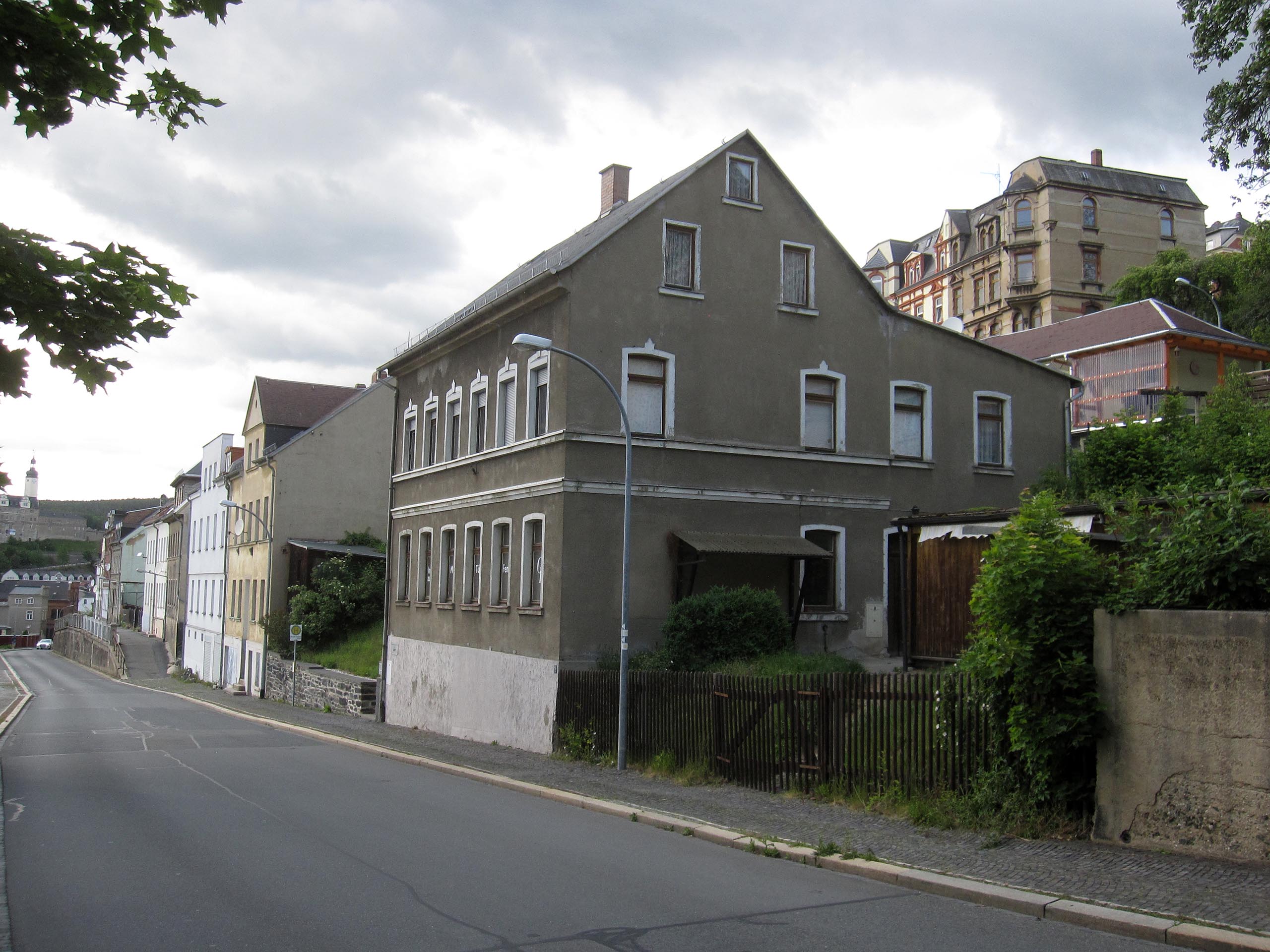
The Dietel family lived in house No. 35 on Obere Silberstraße, which until about 1882 had the number 105. Victor rebuilt it because the previous house had become too small.
Tenement House
The second house was built between 1890 and 1893. Already on 11 February 1894, Victor, as the owner, advertised in the local newspaper for tenants for an apartment on the middle floor consisting of four heated rooms. The grown sons with their families also lived in this building. On the ground floor of the tenement house there was a shop of the firm “Brothers Dietel, Wool Goods Factory.”
House on Cloßstraße
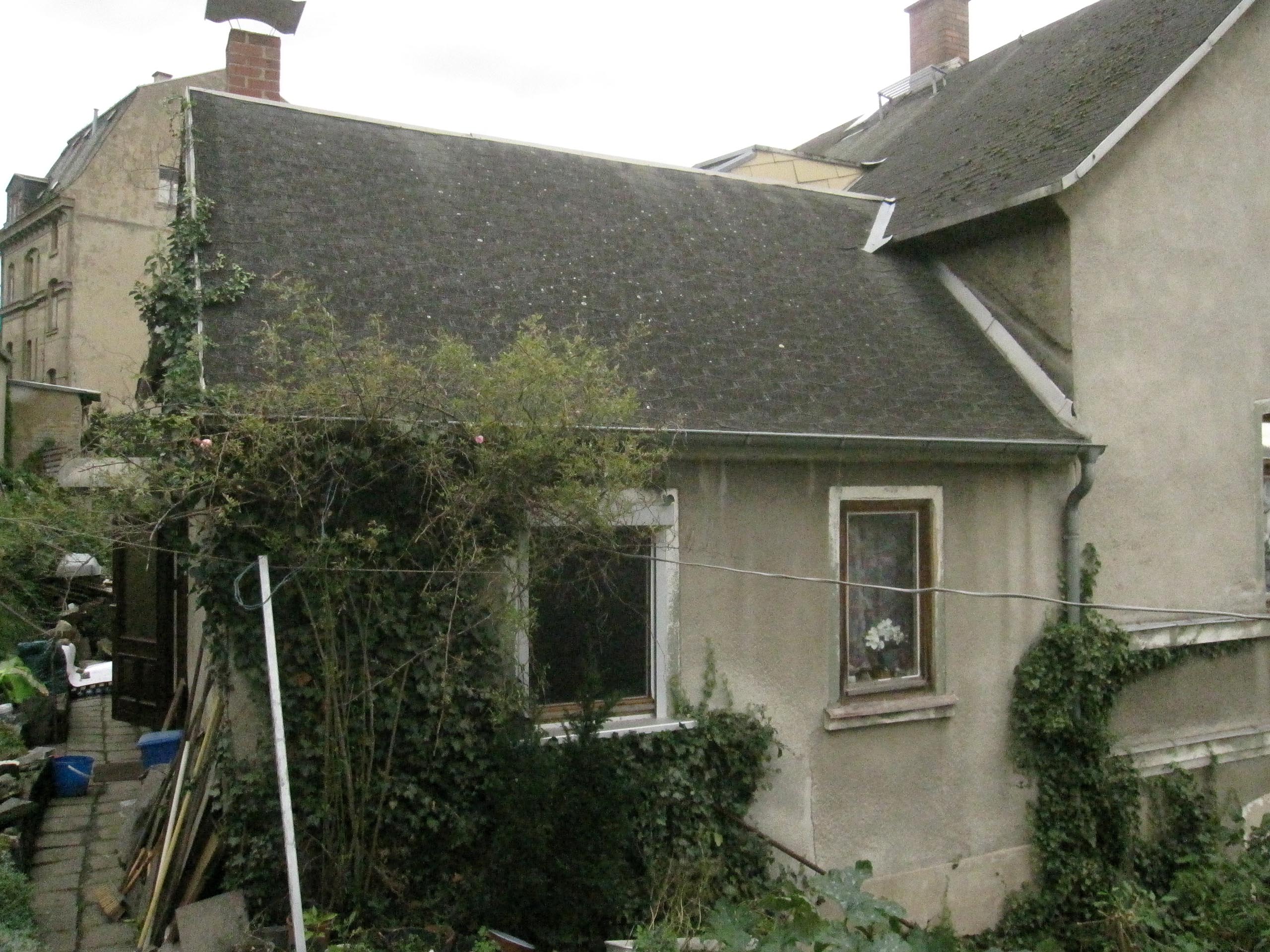
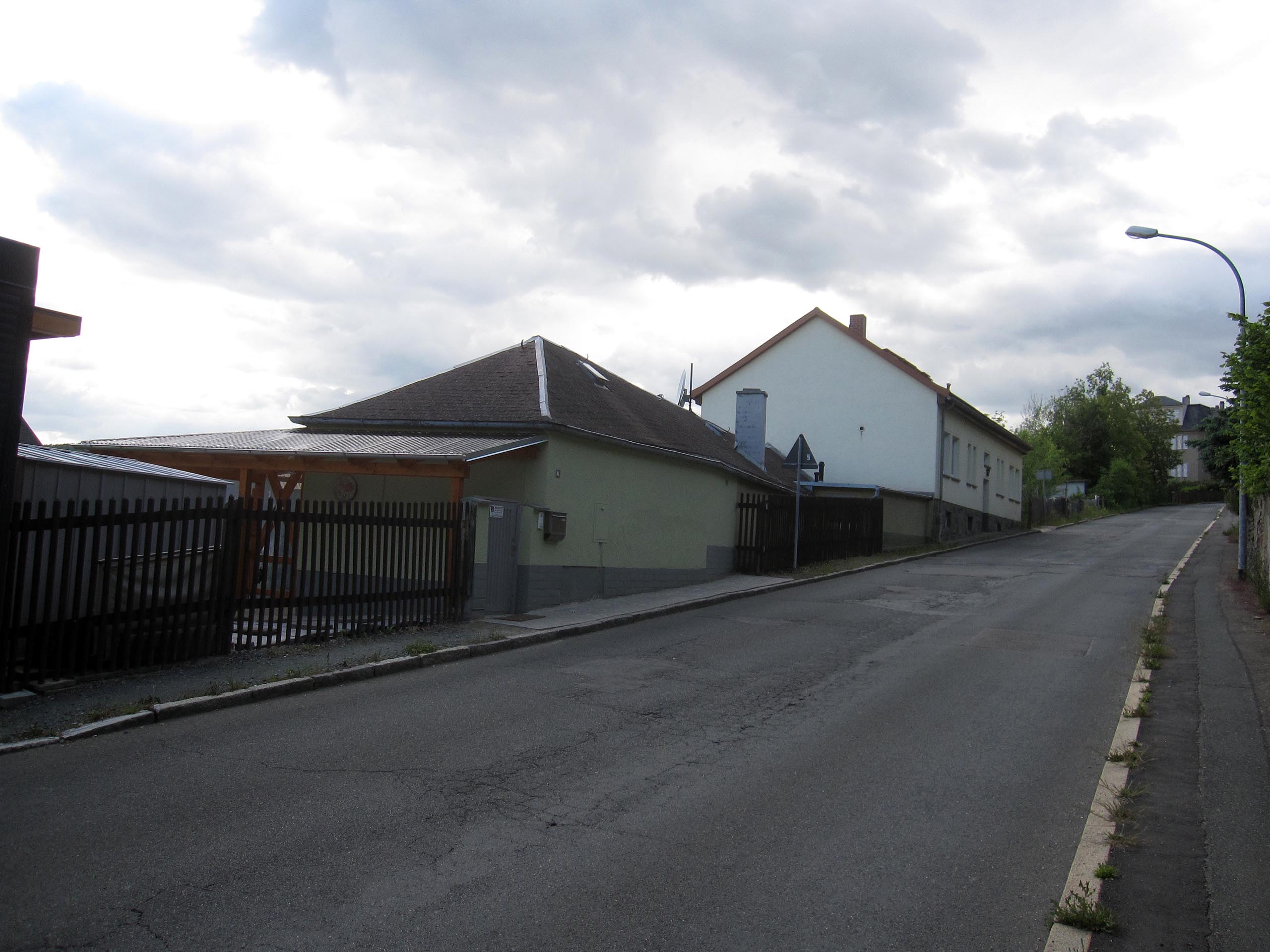
Behind Victor Dietel’s house No. 35, where there was not yet a street, stood a long (40 m) heated single-storey building which apparently housed his finishing (appreture) enterprise. In the mid-1890s the street Cloßstraße was laid out behind it, and from 1920 this single-storey building was adapted into a residential house; therefore it has no windows facing this street.
School Plots 1891 — 1st District School (n. Rep. A. Cap. XIV Nr. 270 Bl. 1., Bl. 1 rev.)
18 June. GRS 6. School matter: a decision was made to purchase a building plot belonging to the private owner C. W. Daßler at the beginning of Pohlitzer Straße for the construction of a school, provided that the supreme administrative authority grants permission to build the school building at this location. (ANBl., 23 June)
We respectfully submit to the Princely High Government of the Land the attached petition of the local rentier Victor Dietel requesting permission to establish an access road from Pohlitzerstraße to the Lehmgrube (later Cloßstraße). At the same time we note that we have no objections to the requested permission submitted on 13 August 1887 concerning the development plan for the district Pohlitzberg–Reißberg–Waldberg (…). The development plan and the parceling plan for the Daßler plots on Pohlitzerstraße, also submitted for approval, do not affect the access road.
n. Rep. A. Cap. XIV Nr. 270 Bl. 1., Bl. 1. rev.
n. Rep. A. Cap. XIV Nr. 270 — governmental administrative records containing the parceling plan of the plot on Pohlitzberg belonging to the court supplier Julius Dietel, as well as other parceling plans of the same property and the related petitions for building permits or requests for exceptions. 1891 and later.
15 October 1891. Municipal Administration of the Princely Residence (n. Rep. A. Cap. XIV Nr. 270 Bl. 11., Bl. 11 rev.)
Rentier V. Dietel could not be granted building permission for his application submitted in the spring of this year until an urban development plan approved by the Princely Government for the respective area had been presented. The plan prepared by the municipal authorities initially did not receive such approval; according to the opinion of the Royal Saxon Commission Councillor Barthold, minor modifications were made to it, and with these changes it was approved by supreme decision (rescript) of 19 June 1891. According to this plan, on the basis of which building permission could be granted and which Dietel was of course obliged to follow (§ 1 of the local building regulations), the triangle c-e-f (or, as we designated and required — x-g-f) had to be assigned to the street. This measure was extremely useful and necessary in the interest of traffic, since in the future the main traffic flow would undoubtedly pass from Pohlitzberg via this access road to Obere Silberstraße, which would require a wide turning movement at this corner. According to § 9 paragraphs 1 and 2 of the local building regulations, Mr. Dietel was obliged to transfer this triangular plot to the town free of charge, since on the one hand it concerned land required according to the development plan for public streets and squares, and on the other hand it concerned a corner house for which the plot bounded by the façade lines extended to the center of these streets must be transferred free of charge. (…)
14 July 1893. Municipal Administration (n. Rep. A. Cap. XIV Nr. 270 Bl. 14., Bl. 14 rev.)
When developing the urban plan for the Reißberg district, the municipal authorities attempted to comply with the request of the Princely High Government that streets should, wherever possible, have a gradient of no more than 1:15. If this principle is to be applied consistently, then given the difficulties of the terrain it is naturally impossible to consider the property boundaries of individual owners; the owners must come to agreements among themselves and exchange land if they do not wish to suffer disadvantages. This is also the case with Randel’s petition — we cannot support it.
Interesting
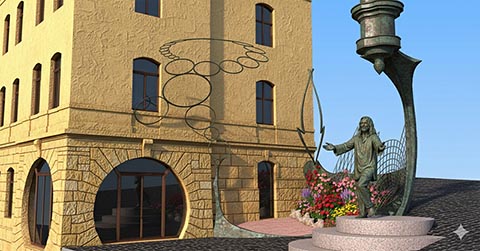
Istvanplatz in front of the Victor Dietel apartment building in Greiz — a Istvan Sky memorial project.
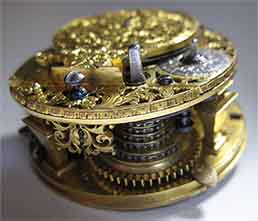
Repair and restoration of bracket clock with a verge escapement, is activated by a fusee (snail) and chain.
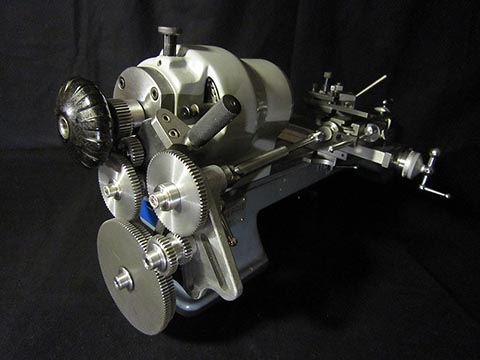
Threading attachment for Schaublin 70 handmade 2016 by Alexander Babel.
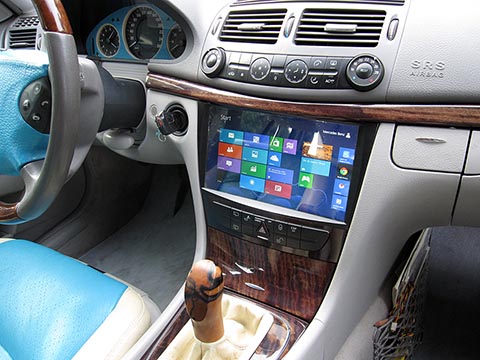
Car-PC for Mercedes Е Klasse W211. Designed and manufactured 2014
Contact
Alexander Babel is autodidakt as designer, engineer, precision mechanic, toolmaker, watchmaker and goldsmith.